
Building a knowledge base for your content with Claude Code: the method, step by step
By Adrien Asselineau · · 13 min read
A knowledge base for content is the list of what your site claims that can go out of date: first your prices, your offer, your lead times, your guarantees, your terms; then the rules and figures of the world your pages depend on. Each fact fits in one sentence, with its source, the date it was checked and the date it must be reviewed. This is the method I apply with my clients, in five steps, with the CLAUDE.md file that runs it in Claude Code, sent by email. It applies to all your content, not only SEO pages: an internal memory of what your company claims. Fifteen to forty facts are enough to start.
A text is right on the day it is published. Eighteen months later, the page still brings traffic, the price has changed, the threshold has been raised, the date has passed, and nobody has noticed. On the sites I audit, the most-read page almost always carries at least one figure that is no longer true. It is not the fault of the person who wrote it: nothing in the way content is produced plans for the moment it becomes wrong.
A knowledge base fixes this at the root. This article describes the method I apply with my clients, step by step, for those who want to maintain it themselves. It needs a folder of files, Claude Code and one review a month. Suiko, the software I publish, does the same thing at the scale of a site with several thousand pages; I talk about it at the end of the article, and only there.
In short
If you read only this, here is the method in seven points.
- List your offer pages (prices, terms, product sheets), then the regulatory pages, and use the pages that bring traffic to sort them.
- Pick out, in those pages, every claim that can go out of date: a price, a lead time, a guarantee, a rate, a threshold, a date, a rule. Fifteen to forty facts to start.
- Write each fact in one sentence, with its source (the document that sets it for a fact about your offer, the official page for a fact about the world), the date it was checked and the review date.
- Store the facts in a folder of text files, one file per fact, and track them in Git.
- Before writing a text, pull out the facts of the topic; after writing it, check every claim against the base.
- Reread external sources every night, or at least every month; review your internal facts on a fixed date, with a named owner; have every change validated by a human.
- When a fact changes, list the pages that quote it: that is your list of updates.
The CLAUDE.md file that makes Claude Code do all of this is the one in the box above: you receive it by email, as an attachment. The rest of the article explains each step.
What a fact is, and what it is not
A fact, in this method, is a verifiable claim that can change. The price of a subscription. The time it takes to confirm an order. The deposit required. The length of a guarantee. The rate of a tax. The threshold from which a rule applies. The date a reform comes into force. The maximum size of a piece of luggage. Each fits in one sentence, and each has a document or a page somewhere that states it.
There are two kinds, and the first comes before the second. The facts of your offer: what you sell, at what price, within what time, under which terms and guarantees. You decide them, you change them, and they are the facts that most often go out of date on a site without anyone noticing. The facts of the world: the rules, rates, suppliers and destinations your pages depend on. Someone else decides them, and you are subject to them.
Not facts: tone, opinions, advice, stable definitions, descriptions. "Kyoto is a pleasant city in spring" will never go into the base. "Since 1 March 2026, Kyoto's accommodation tax ranges from 200 to 10,000 yen per person per night" goes in, because a text that still gives the old ceiling is wrong.
Every fact has the same shape, seven fields, always the same. The example is a fact about the offer of a travel agency:
| Field | What it holds | Example |
|---|---|---|
| Kind | Your offer, or the world | Offer |
| Topic | One word to classify | Tailor-made tours |
| Rule | The fact in one sentence, with the figure or the date, as a writer can copy it | Since 1 September 2026, a tailor-made tour is confirmed within three working days of receiving the deposit. |
| What it makes wrong | The sentence that can no longer be written | Any text that still promises confirmation within 24 hours. |
| Source | For a fact about your offer, the document that sets it and the person accountable; for a fact about the world, the precise address of the official page | Service charter, approved by management on 1 September 2026; owner: the head of sales |
| Checked on | The date the source was last read | 19 October 2026 |
| Review on | The date to reread the source, whatever happens | 1 September 2027 |
The "what it makes wrong" field is the one people forget, and it is the most useful. It turns a fact into a review rule: when the base says confirmation takes three days, any page that promises 24 hours must be corrected, and you know what to look for. A fact about the world is written the same way: "Since 1 March 2026, Kyoto's accommodation tax ranges from 200 to 10,000 yen per person per night", source the City of Kyoto's page, what it makes wrong: any text that still gives the 1,000 yen ceiling.
Step 1, the inventory
You do not put the whole site into the base. You start with the pages that matter, and you pick out what can go out of date.
Three lists of pages are enough at the start, in this order. The offer pages: prices, terms, lead times, guarantees, product sheets, what you sell and what you promise. The regulatory pages: everything that quotes a law, a rate, a threshold, an administration. The pages that bring traffic: in Search Console, the top fifty pages by clicks over the last three months, used to sort the first two lists and to spot what is missing.
For each page, you pick out the verifiable claims that can change. This is where the assistant saves time: it reads the whole page, proposes the list, looks for a source for each item. You reread, you decide, you delete. A travel agency specialising in Japan gets facts like these, two about its offer, then four about the destination, taken from Suiko's demo base:
- A tailor-made tour is confirmed within three working days of receiving the deposit.
- The deposit at booking is 30% of the trip price, the balance forty-five days before departure.
- Since 1 March 2025, unregistered Suica and Pasmo cards are sold again at Tokyo stations.
- Since April 2024, the private alleys of Gion, in Kyoto, are closed to tourists.
- On the Shinkansen, luggage whose three dimensions add up to more than 160 cm must be reserved in advance.
- On 1 November 2026, tax-free shopping in Japan switches from an exemption at the till to a refund after a customs check.
Six facts, six sentences, six sources. A two-hundred-page travel site has about forty worth tracking, not four hundred. The sorting uses two criteria: how fast the fact can go out of date, and how many readers the page reaches. A regulatory threshold on a page with a thousand visits a month comes before opening hours on a page with ten.
Step 2, the source that counts
For a fact about your offer, the source is the document that sets it: the price list, the terms and conditions, the product sheet, the service charter, or failing that a dated decision by a named person. Your own site is not the source of its own figures: the price list that sets them is, and the page must follow it. Every fact about your offer has an owner, the person who knows when it is going to change; without one, the fact ages in silence, because no robot will come and reread it.
For a fact about the world, the source is a precise official page: the administration, the supplier, the regulatory text. Precise means the address of the page where the figure appears, not the home page of the site that publishes it. That address will be reread a hundred times; if it leads to a menu, the rereading is worthless.
A press article is not a source, nor is a forum, nor a competitor. When the only available source is a dated PDF, a page that requires a login or a screenshot, the fact is kept with that reservation written in its context, and its review date is brought forward.
When the assistant finds no source, the fact is marked "to be sourced" and stays empty. This is the most important rule of the method, and the one assistants break most willingly: a fact without a source is not completed from memory. A language model that writes a figure from memory writes a figure from two years ago with the same confidence as yesterday's.
Step 3, the review date
Every fact carries two dates. "Checked on" says when the source was last read. "Review on" says when to reread it whatever happens, even if nothing signals a change.
The review date depends on the nature of the fact. A fact about your offer is reviewed at the next planned revision (the annual price list, a product release, the season), and its owner is warned a few days before. Suppliers' prices are reviewed every three months. Regulatory rules and thresholds are reviewed at the next known date of entry into force, or every six months when it is unknown. Event dates are reviewed the day before the event, then a year later. Anything whose pace of change you do not know is reviewed every three months, and adjusted at the second reading.
The ritual that holds all this together is short: on Monday, the list of facts whose review date has passed, then those due within thirty days. About twenty minutes for a base of forty facts.
Step 4, the base inside the writing
A base nobody reads is useless. It enters the writing at two moments.
Before the text, in the brief: the person writing receives the facts of the base that concern their topic, with their rule and their check date. They no longer have to look for the figure, nor guess it, nor copy the one from a competitor's page that copied it from another.
After the text, in review: every verifiable claim of the draft is checked against the base, and only against the base. For each one, a one-word answer. "Consistent", with the name of the fact. "Contradicted", with the fact and the exact sentence of the text. "Absent from the base". Never "probably true". A claim absent from the base is not settled by the assistant with its own knowledge: it is proposed for the inventory, and a human decides whether it goes in.
This review is the one that changes the quality of texts the most, because it catches errors where they cost the least: before publication.
Step 5, monitoring the sources
Facts about the world change without warning. Monitoring means rereading their sources and flagging what has moved. It does not cover the facts about your offer: they have no page to reread, they have an owner and a date.
The handmade version: a monthly rereading of all sources, on the Monday they fall due. The tooled version: a scheduled task that, every night, rereads each source and answers with a single word. "Unchanged". "Changed", with the excerpt of the source that contradicts the rule and the proposed new rule. "Unreadable", with the reason: page gone, login required, content loaded by script. In the morning, a report, and facts to validate.
In both versions, the same rule: monitoring proposes, it does not write. A fact is only changed in the base by a human who has read the excerpt. And when a fact is out of date, the list of pages that quoted it becomes the list of updates to make, in order of traffic.
The setup, to do it yourself
Here is the setup I use, for someone comfortable with a terminal. It takes half a day the first time.
- A private Git repository, on GitHub or elsewhere, with a
facts/folder. One Markdown file per fact, namedtopic-keyword.md, with the six fields at the top of the file. Git gives you the history of every fact for free: who changed what, when, on which source. - The instructions file, at the root of the repository, named
CLAUDE.md. It is the file sent by email from the box at the top of this article, with the name of your site and your first name in place of the brackets. It describes the format of a fact, the source rule, the review dates, the review of a text and the monitoring, in the terms of this article. - An assistant that reads this file. Claude Code, opened in the repository folder, reads it at startup; a claude.ai project accepts it as instructions. Other desktop assistants, ChatGPT or Gemini for example, accept the same text in a project's instructions; only the nightly task needs a command-line tool. The inventory is done by giving it page addresses, the review by giving it a draft, the monitoring by asking it to reread the sources.
- A scheduled task for monitoring, if you want the nightly version: a GitHub Action that, every night, runs the assistant from the command line with the instruction "reread the sources of the valid facts and return the report", and commits the report to the repository. This needs an API key from the assistant's provider, stored in the repository secrets, and a few cents a night for forty sources.
- A Search Console export, once a quarter, to refresh the list of pages that bring traffic. A CSV file is enough, no key.
Nothing here is secret, or hard. People who work with these tools every day will recognise a method that has become common. What makes it rare is that it is kept up over time: the review Monday that gets skipped, the morning report nobody reads, the fact changed without rereading. The method is worth what the discipline is worth, not the setup.
What not to do
Keeping the base for regulation only. The most frequent error on a site is not a misquoted law, it is the price on the home page that did not follow the price list, or the lead-time promise written three different ways on thirty pages. The base starts with your offer.
Putting the whole site into the base. Four hundred facts of which three hundred will never change is a base nobody rereads. The base holds what can go out of date, on the pages that matter.
Believing the assistant fills it on its own. It proposes well, it sources sometimes, it makes things up as soon as you let it. Every fact enters the base after a human has read its source.
Confusing "checked against the base" with "true". A text consistent with a base whose sources have not been reread for a year is consistent with an outdated base. Checking texts is only worth something if the monitoring of sources runs. An SEO manager who read this method summed up the risk in one sentence: the base must be at least as fresh as the texts it checks.
Storing the source without the date. An address without a "checked on" is an address you will never know when to reread.
How long it takes
For a site of two hundred pages and a base of forty facts, by hand and with an assistant:
- the first base, inventory and sources included: one day, half of it rereading what the assistant proposes;
- the Monday review: twenty minutes a week;
- the monthly monitoring of sources, without a scheduled task: one hour a month; with the nightly task, ten minutes reading the report per week;
- checking a text against the base: five minutes per text, most of it reading the discrepancies.
Beyond a hundred facts, or a few hundred pages, the minutes become hours, and that is when a tool replaces the setup.
Suiko
Suiko is the software I publish, and this method is the one it applies. The knowledge base there is a screen that opens on your offer, then on the external rules and figures: every fact with its rule, its source or its owner, its two dates and its status, imported from your offer pages and then your regulatory pages at onboarding, and completed as texts are written. The brief generated for each piece of content holds the facts of the topic. The text's score includes a family "the facts are right", checked against the base. Monitoring rereads the sources of the facts about the world every night, flags what has changed and waits for your validation; the facts about your offer come back to their owner on the planned date. When a fact changes, the updates of the pages that quoted it are prepared by a machine that corrects the fact and leaves the rest of the text intact, then reviewed by you.
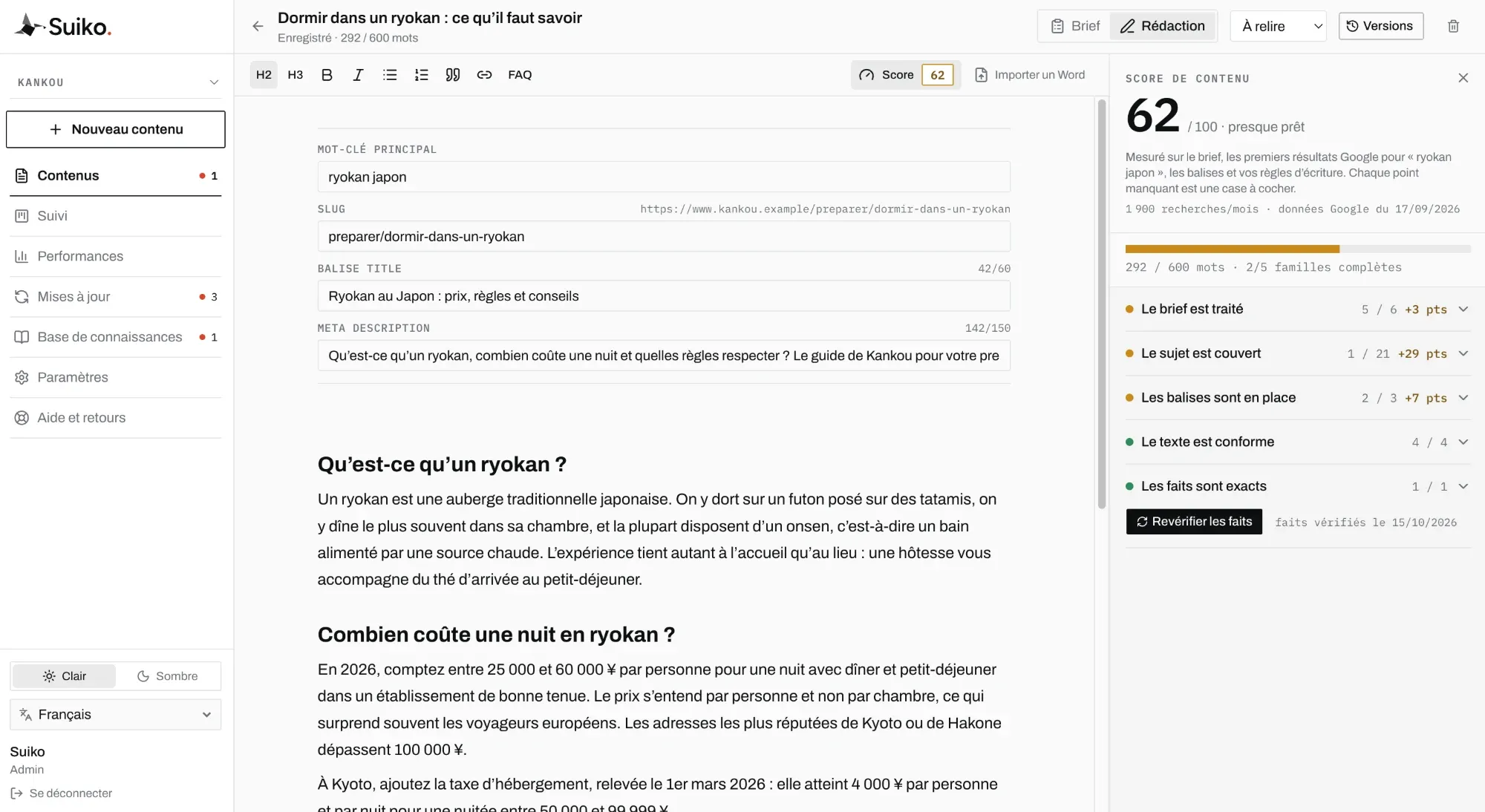
The setup described above does the same thing for forty facts. Suiko does it for thousands of pages, with the writers, the validation workflow and publishing in the same tool, from €149 per month excluding VAT. For someone who runs a two-hundred-page site, the Git repository and the instructions file are enough, and that is perfectly fine.
Frequently asked questions
Is a knowledge base for content the same thing as a knowledge base for customer support?
No. A help centre answers customers' questions with whole articles. The base described in this article only holds facts: one sentence, one source, two dates. It serves the people who write and the tools that check, not the visitors of the site.
Do you need a tool to maintain this base?
No. A folder of text files in a Git repository, or a six-column spreadsheet, is enough for a few dozen facts. Tooling becomes useful when monitoring the sources and checking the texts take more than an hour a week, that is beyond a hundred facts or a few hundred pages.
How many facts do you need to start?
Between fifteen and forty. First the facts of your offer (prices, lead times, guarantees, terms), then those of the regulation of your sector, starting with the pages that bring traffic. The rest comes with the updates, at the pace of the changes.
Can AI fill the base on its own?
It can propose the facts and the sources, and reread the sources every night. It must never write a fact into the base without a human validating it. A base filled without review holds wrong facts, and a text checked against a wrong base is wrong with a verification stamp on it.
How this article was written
This article describes a method the author applies with his clients; it rests on his experience, not on a reading of vendors’ sites. The facts quoted as examples come from Suiko’s demo base and were reread on their official sources. Facts checked on .
Transparency: the author publishes Suiko, one of the tools mentioned. The factual elements are sourced so that you can verify them yourself.

Adrien Asselineau
SEO consultant, founder of Suiko
An independent SEO consultant since 2015, Adrien Asselineau helps marketing teams with their organic search. He built Suiko to run content written by humans, with verified facts.
Not ready yet?
Two free tools, no account needed.